Distinguished Authorities, colleagues, fellow Italians, dear friends of Italy, it is my great pleasure to welcome you to our celebration of Italian Republic Day.
Today’s celebration marks the 80th anniversary of that 2nd of June 1946, when millions of Italians were called upon to vote in a referendum and choose between the monarchy and the republic.
For the first time, women were among them. As you entered this hall, you may have noticed an exhibition dedicated to those historic days.
It was truly a founding moment, marking the transition to a new and young Italy. In the aftermath of the war, Italy chose freedom, democracy, multilateralism, and Euro-Atlantic integration.
This day is not only about remembering the past, but also reflecting on the present. In a difficult international context, Italy seeks to act as a force for stability and dialogue, both within the framework of the European Union and in the broader Mediterranean and Balkan region.
It is from this vision that our country’s strong support for Bosnia and Herzegovina’s Euro-Atlantic path stems. We encourage all political actors to renew their focus on the EU path and on advancing reform actions that support BiH’s stability, sovereignty, prosperity and the functionality of state level institutions.
To achieve this, strong determination is needed from the local political leadership, together with the courage to reach compromises for the common good and the ambition to leave a meaningful legacy for the Bosnia and Herzegovina of the future.
Citizens believe in this path: they want to join the EU for a future built on prosperity, opportunity, the rule of law and freedom. We stand with them, and we always will.
At the same time, Italy — which has consistently supported dialogue among all internal stakeholders in Bosnia and Herzegovina and the search for domestic solutions — supports the mission of the High Representative in implementing the 5+2 Agenda.
I would like to take this opportunity to thank Mr. Christian Schmidt for his extraordinary commitment and contribution to the implementation of the Dayton Agreement over the past five years.
Italy supports the independence, sovereignty, and territorial integrity of Bosnia and Herzegovina. It does so also through the contribution of our military personnel to the EUFOR Althea mission, the command of which we have resumed this year.
I would like to extend my greetings to the Commander, General Maurizio Fronda, and express my esteem and gratitude to all Italian military personnel serving in Bosnia and Herzegovina.
I also wish to acknowledge our fellow Italian citizens residing in the country, as well as the historic Italian communities of Tuzla, Stivor and Banja Luka, which continue to keep alive the bonds between our peoples.
I would like to express my special thanks to all students of the Italian language in Bosnia and Herzegovina, true builders of bridges of friendship, dialogue and mutual understanding between our peoples.
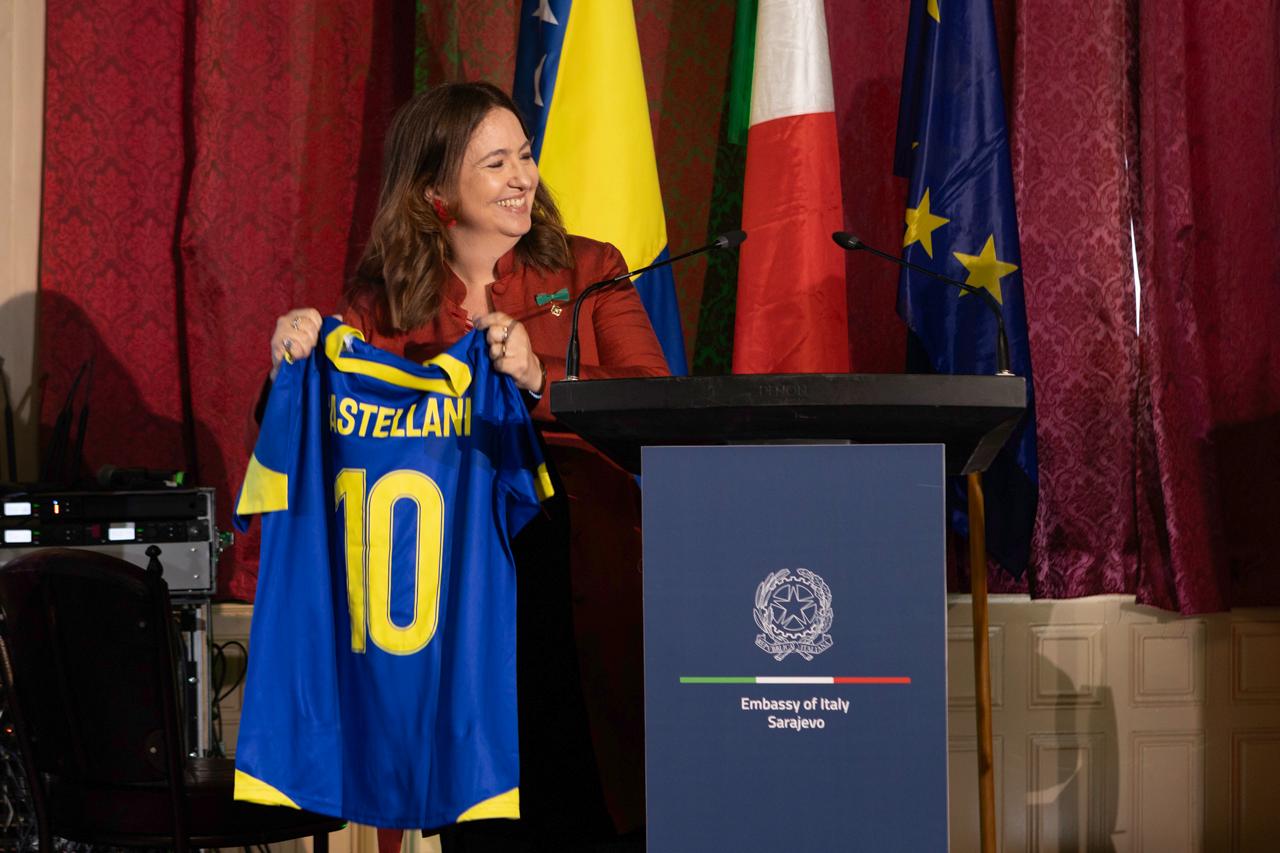
This year our national football teams met in Zenica. As we have already said, the better team won and, although we were sad about it, your joy was our greatest comfort.
Before the match, many recalled that on the sixth of November nineteen ninety-six, another important match was played at the Koševo Stadium between Italy and Bosnia and Herzegovina: the first match for the Bosnian national team after the war. It was a gesture of friendship, solidarity and hope, and one of the first major international sporting events in post-war Sarajevo.
I find it particularly meaningful to read to you this evening some of the comments we received on our social media platforms ahead of the match in Zenica.
“True respect cannot be imposed; it must be earned. And Italy has earned it because it stood by our side when we needed it most”. “Thank you, Italy. You were our friends in the most difficult times”. “Before and after the match, Italy is a great friend of ours. The only question that remains is: which is better, ćevapi or pizza?”
This is a genuine bond, deeply rooted in our shared history, cultural and human connections, mutual curiosity, and an instinctive sense of closeness that, it would appear, transcends political relations. In light of these remarks, I believe it will be much easier for all of us to support Bosnia and Herzegovina at the next World Cup!
Sport truly conveys values of friendship, respect, and cooperation, such as those promoted by the Olympic Games, which Italy was proud to host this year in Milan and Cortina: another thread linking Italy and Bosnia and Herzegovina through the memory of the 1984 Winter Olympics in Sarajevo.
On the occasion of the match in Zenica, many people told us: “Italy has always been here.” And it is true. Italy has always been here. And it still is today: politically, economically, culturally, and through development cooperation.
In 2025, Italy confirmed its position as Bosnia and Herzegovina’s leading supplier and second overall trading partner with annual bilateral trade worth around €2.7 billion. Italian companies here employ more than 13,000 workers, making a significant contribution to local economic growth.
Also in 2025, Italy committed more than 9 million euros in development assistance to Bosnia and Herzegovina across many sectors: from migration management to agriculture, eco-sustainable tourism, ethnic reconciliation, humanitarian response efforts, and much more.
There is one project in particular that is expected to be financed through these funds: the construction of the Ars Aevi Museum of Contemporary Art, which, as is well known, has a strong Italian imprint. The first artworks came from Italy, and the Museum itself was designed by the architect Renzo Piano.
This is a project we are proud to support, convinced that culture and architecture can become tools for urban regeneration, inclusiveness, and dialogue. I am very pleased to announce an important development in the implementation of the project: UNESCO has approved the contract with the selected construction company, and the construction of the museum is expected to begin in the coming days.
I would like to thank UNESCO for the incredible work done so far, as well as the European Union, the Canton of Sarajevo, the City of Sarajevo, the Municipality of Novo Sarajevo and all the partners who, like Italy, are contributing to the realization of the project.
In conclusion, I now leave you to the music of the Tuscan group Musica da Ripostiglio (meaning “Storage Room Music” because, as they say, “chamber music” sounded too pretentious), whom I warmly thank for being here.
At the end of their short musical performance, you will have the opportunity to enjoy some Italian food specialties: we are proud that only a few months ago UNESCO officially recognized Italian cuisine as an “Intangible Cultural Heritage of Humanity”.
It became the first national cuisine to receive recognition in its entirety, not just for a single dish or culinary practice.
Let me thank my colleagues Gioia and Riccardo and the entire Embassy staff, whose daily work makes an indispensable contribution to strengthening bilateral relations between our countries.
Finally, I would like to thank our sponsors, Intesa Sanpaolo Banka and UniCredit, for supporting our initiatives to promote Italy, and Manuel Cafè and Auto Centar Italy for their contribution to this evening”.
Long live Italy! Long live Bosnia and Herzegovina! Long live the friendship between our peoples and… Good luck, Dragons!